Canada
Overview
| Flag |
|
Anthem
|
O Canada Watch on youtube (with lyrics)
God Save the Queen (royal anthem) Watch on youtube (with lyrics)
|
| Capital |
Ottawa |
| Largest city |
Toronto |
| Official language(s) |
English / French |
Demonyma name for a resident of a locality, often the same as the name of the people's native language
|
Canadian |
| Government |
Federal parliamentary democracy and constitutional monarchy |
| Area |
9,984,670 km2, 3,854,085 sq mi |
| Population |
~ 34 million |
| Currency |
Dollar (CAD) |
| Internet TLD |
.ca |
Geography
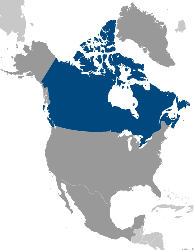
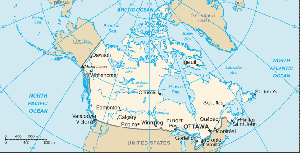
Canada is a country
occupyingto fill either time or space most of northern North America, extending from the Atlantic Ocean in the east to the Pacific Ocean in the west and northward into the Arctic Ocean. It is the world's second largest country by total area. Canada's common border with the United States to the south and northwest is the longest in the world.
Canada's capital city is Ottawa. It is the fourth-largest
municipalitya district with a government that typically encloses no other governed districts in the country with a population of 1,130,761. The three largest cities in Canada are Toronto, Montreal and Vancouver. Toronto, the largest city in Canada, has a population of 5,113,149.
Society and culture
Canadian culture has historically been influenced by British, French, and
aboriginaloriginal or indigenous to a place cultures and traditions. There are distinctive Aboriginal cultures, languages, art, and music spread across Canada.
Population
Canada's total population in July 2010 was estimated to be 33,759,742 people. Population growth is from
immigrationthe passing or coming into a country for the purpose of permanent residence and, to a lesser extent, natural growth. About four-fifths of Canada's population lives within 150 kilometres (93 mi) of the United States border. According to the 2006
censusan official count of members of a population, the largest reported ethnic origin is English (21%), followed by French (15.8%), Scottish (15.2%), Irish (13.9%), German (10.2%), Italian (5%), Chinese (3.9%), and Ukrainian (3.6%).
Languages
Canada's two official languages are English and French. English and French have equal status in federal courts, Parliament, and in all federal institutions. English is the
mother tonguethe language one learned first; one's native language of 59.7% of the Canadian population, while French is the mother tongue of 23.2%. More than 85% of French-speaking Canadians live in Quebec. Over six million people in Canada list a non-official language as their mother tongue. Some of the most common non-official first languages include Chinese, Spanish, Italian and German.
Religion
Support for religious
pluralisma social system based on mutual respect for each other's cultures among various groups that make up a society is an important part of Canada's political culture. According to the 2001 census, 77.1% of Canadians identify as being Christians; of this, Catholics make up the largest group (43.6%). The largest Protestant
denominationa religious society of individuals, called by the same name is the United Church of Canada (9.5%), followed by the Anglicans (6.8%), Baptists (2.4%), Lutherans (2%), and other Christians (4.4%). About 16.5% of Canadians declare that they are not religious. The remaining 6.3% are
affiliatedto be a member of, to be connected to with non-Christian religions, for example with Islam (2.0%) or Judaism (1.1%).
Government and politics
Canada is governed as a parliamentary
democracya government under the direct or representative rule of the people and a constitutional monarchy, which is the foundation of the
executiveresponsible for enforcing laws and judicial decisions,
legislativeresponsible for making a law, and
judicialresponsible for maintaining the courts of law branches. The
sovereigna monarch; the ruler of a country is Queen Elizabeth II, who also serves as head of state of 15 other Commonwealth countries and resides predominantly in the United Kingdom. The Queen's representative, the Governor General of Canada (presently Michaëlle Jean) carries out most of the royal duties in Canada.
Economy
Canada is one of the world's
wealthiestrich, having much money nations, with a high per-capita income. Canada is one of the few developed nations that are net exporters of energy. Also, it is one of the world's largest
suppliersproviders of agricultural products. The Canadian economy is dominated by the service industry. In the past century, the growth of the manufacturing,
miningthe business of removing solid valuables from the earth, and service sectors has transformed the nation from a largely
ruralless-populated, non-urban areas economy to a more industrial and urban one. As of October 2009, Canada's national unemployment rate was 8.6%.