Nigeria
Overview
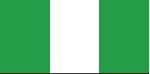
| Flag |
|
| Anthem |
Arise Oh Compatriots, Nigeria’s Call Obey
Watch on youtube (with lyrics)
|
| Capital |
Abuja |
| Largest city |
Lagos |
| Official language(s) |
English |
Demonyma name for a resident of a locality, often the same as the name of the people's native language
|
Nigerian |
| Government |
Presidential Federal republic |
| Area |
923,768 km2, 356,667 sq mi |
| Population |
~ 155 million |
| Currency |
Naira (₦) (NGN) |
| Internet TLD |
.ng |
Geography
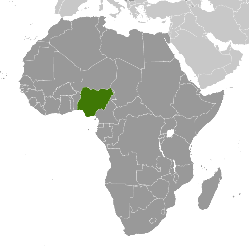
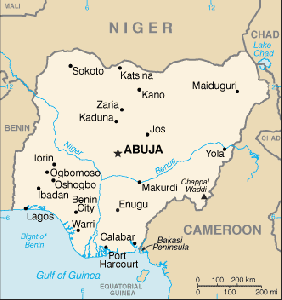
Nigeria, officially the Federal Republic of Nigeria, is located in West Africa and shares land borders with the Republic of Benin in the west, Chad and Cameroon in the east, and Niger in the north. Its coast in the south lies on the Gulf of Guinea on the Atlantic Ocean.
Abuja is the capital city of Nigeria. It is located in the centre of Nigeria in the Federal Capital Territory (FCT). Nigeria has six cities with populations of over 1 million people: Lagos (7,937,932), Kano (3,848,885), Ibadan (3,078,400), Kaduna (1,652,844), Port Harcourt (1,320,214), Benin City (1,051,600), Maiduguri (1,044,497) and Zaria (1,018,827). Lagos is the largest city in sub-Saharan Africa, with a population of over 10 million in its
urbanrelated to a city area alone.
Society and culture
Due to a high number of ethnic groups in the country, Nigeria has a very diverse culture. Nigeria is famous for its English language literature and its popular music. Since the 1990s the Nigerian movie industry, sometimes called "Nollywood" has
emergedto become known, to come out of a situation as a fast-growing cultural
forceanything that is able to make a big change in a person or thing all over the continent. All over the country, and even increasingly in the conservative north, western music, dresses and movies are ever popular.
Population
Nigeria is the most
populoushaving a large population; densely populated country in Africa. The United Nations estimates that the population in 2009 was at 154,729,000,
distributedto classify or separate into categories as 51.7% rural and 48.3% urban, and with a population density of 167.5 people per square kilometer. Nigeria has been undergoing explosive population growth and one of the highest growth and
fertilitythe birthrate of a population rates in the world. Nigeria has more than 250 ethnic groups, with varying languages and
customshabitual practice; method of doing or living, creating a country of rich ethnic diversity. The largest ethnic groups are the Fulani/Hausa, Yoruba, Igbo, accounting for 68% of the population, while the Edo, Ijaw, Kanuri, Ibibio, Ebira Nupe and Tiv comprise 27%. There are many small minorities, for example of British, American, East Indian and Chinese origin.
Languages
The number of languages currently estimated in Nigeria is 521. This number includes 510 living languages, two second languages without native speakers and nine
extinctno longer used; obsolete, discontinued languages. In some areas of Nigeria, ethnic groups speak more than one language. The official language of Nigeria is English. It was chosen to
facilitateto make easier the cultural and linguistic unity of the country. Still, English remains an exclusive
preservesomething that is protected, kept, maintained of a small minority of the country's urban
eliteof high birth or social position, and it is not spoken at all in some rural areas.
Religion
Nigeria is home to a variety of religions which
tendto be likely, or probable to do something, or to have a certain characteristic to vary regionally. This situation has often been seen as a source of
sectarianbetween different sects of the same religion conflict amongst the population. The largest religions of Nigeria are Islam and Christianity, including many followers of
indigenousnative to an area or a country religions. Based on a 2003 survey, 50.5% were Muslim, 48.2% were Christian (15% Protestant, 13.7% Catholic, and 19.6% other Christian), and followers of other religions were 1.4%. The core north is largely Muslim while southern regions are
predominantlymostly, frequently by a large marginChristian. Other minority religious and spiritual groups in Nigeria include Hinduism, Judaism, The Bahá’í Faith, and Chrislam.
Government and politics
Nigeria is a federal constitutional republic comprising thirty-six states and its Federal Capital Territory, Abuja. The Republic is modelled after the United States, with
executiveresponsible for enforcing laws and judicial decisions, and for the day-to-day running of the state power exercised by the president and with
overtonesan implicit meaning of the Westminster System model in the composition and management of the upper and lower houses of the
bicameralconsisting of two chambers legislature. The current president of Nigeria is Goodluck Jonathan. The president
presidesto exercise authority or control as both Head of State and head of the national executive and is elected by popular vote. The president's power is checked by a Senate and a House of Representatives, which are combined in a bicameral body called the National Assembly. The country has a judicial branch, the highest court of which is the Supreme Court of Nigeria.
Economy
The economy of Nigeria is one of the fastest growing in the world and the third largest economy in Africa. It is classified as an
emergingbecoming prominent; newly formed market, and has already reached middle income status according to the Worldbank, with its
abundantfully sufficient; found in copious supply; in great quantity supply of natural resources, well-developed financial, legal, communications, transport sectors and stock exchange. Nigeria is the United States' largest trading partner in sub-Saharan Africa and supplies a fifth of its oil. Nigeria also has a wide array of
underexploitednot exploited to any great extent; not used to full advantage mineral resources. It also has a manufacturing industry which includes leather and textiles, car manufacturing, t-shirts, plastics and processed food.